

Author: Gvantsa Lomaia.
*All photographs by Gvantsa Lomaia
I only go to a small neighborhood grocery store – a “minimarket” – near my apartment block for two reasons: to buy cheap sausages for Rizha, the ginger stray dog we all have joint custody of, and whenever the supermarkets are closed.
Not that there are many options around. The ground floor of the newly built apartment block in Tbilisi’s Sanzona area where I live is occupied by commercial spaces, and many businesses have opened and closed there over the past decade: a gym, a mattress store, a used car parts shop, a delivery service, and a cafe that was a bit too cool for this place, but never one of those chain shops and supermarkets.
You have to walk blocks to reach them — the Nikora, the Libre, the Gvirila, the 2 Nabiji. Except for Europroduct – we haven’t quite made it to Europroduct territory yet.
So, before that particular kind of civilization reaches me with its loyalty cards, offers, discounts, and constantly rearranged shelves, I have to settle for a small non-chain mini marketi “Smile” nearby, where there is nothing to smile about, at least not at first glance.

The shop is always there, day and night, winter and summer.
Inside, everything is remarkably stable too: same products, same prices — if the prices ever change, it’s only upward. The bread is always in its place, so is the sausage, and so are the rock-hard Armenian gadas baked in someone’s home kitchen. There are no discounts, no special apps, and no notifications about offers. It doesn’t give me points, and neither does it ever remind me that I am a “valued customer.” It just stays open.
The only thing I see changing more or less regularly is the staff. I suspect the business does not offer high salaries.
And that’s why I keep wondering about the people who actually keep it going. Do they survive on regular customers? Do they still keep those old “nisia” notebooks where they record the products given out on credit? Does the staff have favourite customers?
What is it that still lures all those people in there?

They’re just too lazy to stand in line elsewhere, so the shopkeeper, the middle-aged Maya who works at my beloved corner shop, explains. “And also they love this shop,” she adds, somewhat surprised. She is sparing with her words, and I never get to ask her what it meant exactly to love your neighbourhood shop.
So I wander through different streets across the city, hoping at least other weary shopkeepers will tell me how, and why, a person might grow attached to their corner shops with the meagre selection of goods they offer.
That’s how I realise there are fewer such shops around than I imagined — the market giants have occupied all the strategic places. On those rare occasions I do find one, I’m not very welcome with my questions.
Perhaps the staff, often young people, simply don’t care – what kind of question is it anyways, whether they have a “favorite customer”… Or perhaps they think I am some kind of intrigani – a provocateur, someone trying to get them into trouble for one reason or another. You can’t trust anyone these days.

Or they are just tired – there is a visible sense of exhaustion on almost every face.
That’s one of the strange things about the fragile stability these shops offer: with no central corporate policies, you never know who and what awaits you there. Let it surprise you.
But at least Elza, a shop owner in Chugureti, is happy to talk, and, unlike most of the other shopkeepers I meet, she only warms up after learning I am a journalist. She asks me to remind the government that small business owners are struggling and would use some attention — I’ve already gathered as much myself.
Elza chats with me even if she, too, must be quite tired: she’s spent more than a decade in this shop. She’s the owner, assistant, accountant, and cleaner there. She and the shop barely manage to keep going, she says.
“She never lets us down,” a man says, taking his half-litre bottle of Coke without paying and sitting down next to us. A regular customer. “We rarely have money that lasts from paycheck to paycheck; we come to Elza, and she lets us take everything on credit, and we pay when we get paid,” he tells me, happy to explain the remnants of what used to be a much more widespread nisia culture.

Nisia means debt in Georgian. Since I can remember, the term has only ever been used in the financial dealings of neighbourhood shops.
Back in the day, Georgian shopkeepers made it no secret that they’d rather be paid immediately than give products out on nisia, or credit, on the shaky promise that the customer would send the kid to settle the debt later. There were thick nisia notebooks inside every shop, but also door signs outside trying to scare away cashless customers overreliant on nisia — “Nisia Skhvisia” – “credit is for someone else” – a phrase that only really lands for native speakers.
But as more chain shops and supermarkets pop up in city neighborhoods with all their apps, discounts, and offers, minimarkets may be left with nisia as the one remaining offer their customers cannot refuse: the possibility of not paying at all, not immediately at least.
“If my neighbourhood weren’t standing behind me, I probably would have closed long ago,” Elza tells me, as she explains to a customer who has just walked in how to pay by card on her own. At least the self-checkout option has reached her shop sooner than many of the new chain supermarkets around: Elza uses a crutch, and she would rather trust her customers with the bank terminal than walk to the counter from the seat built into the pavement outside.
Then she shows me one of the credit slips she has come up with herself. Instead of the good old nisia notebook, she writes the price of whatever a customer takes on credit on a separate piece of paper and hands it to them. There’s no name, surname, or date on it. When they come back, they simply bring their own slip. The whole system rests on two things: Elza recognising her own handwriting and trusting that her neighbours won’t lie to her.

Dodo and her assistant also keep the nisia records, but they prefer to attribute their survival to their shop’s strategic location. The shop stands next to a big Carrefour supermarket, and the staff takes great pride in holding out against strong competition.
“It’s a good location; the tire-repair workers always come to us – because we praise them, we serve them, we chat with them, we say a kind word. … We take care of our customers,” she says, turning to a customer who has just walked in. “How can I help you, dear?”
In a world of supermarkets versus minimarkets, a greater competition may be the one between trust and distrust.
I’ve noticed that minimarket workers do not usually love the spotlight: often, my camera seems only to make the pervasive political distrust and economic insecurity worse.
But they still appreciate being seen.
Dodo happily recalls the COVID period, when someone wrote a viral social media post acknowledging the invisible role shops like theirs played, and how their nisia culture must have saved thousands of people from hunger when they suddenly lost their income or their wages were delayed.
That invisibility has now increasingly turned into physical disappearance.
Non-chain shops are being slowly defeated by the market and quietly disappearing, leaving behind painfully empty stalls, a grieving neighbourhood, and more memories than I ever would have imagined a shop could hold.

That’s how I happen to witness the closing of Papa Karlo’s in Saburtalo, after a friend invites me to visit it following my complaints that I could not find enough small shops around.
It is an unhappy coincidence: having served the neighborhood since 1998, I arrive at the shop just as its doors are covered with “Liquidation” signs, along with banners offering the products at dramatically discounted prices. Inside, the shelves are being emptied as people circle the small premises in anxious disbelief. With a line of saddened customers, the scene resembles a funeral.
“Times rule, not the rulers,” the shopkeeper replies to one of them, a Georgian phrase about the impossibility of outlasting time.
I am told in the shop that one reason for going out of business was the inability to compete with the chains – the small shop cannot buy the products in bulk, so the distributors charge them more.
The new signs appearing on the doors suggest that a dairy shop might open there. That’s one way for smaller businesses to still make it in a market dominated by giants – by offering locals a greater selection of a single type of product – a dairy shop, beer shop, fruit and vegetables, hygiene items. But not those small grocery “everything” shops – there is no beating supermarkets.

“End of an epoch,” locals lament, describing Papa Karlo’s as one of the “constants” of the city, a neighbourhood landmark, a spot that had served as a geographical reference point since forever. “I’m at Papa Karlo’s.” “I passed Papa Karlo’s.” Some also remember the thick nisia book that used to lie there.
I leave Papa Karlo’s without buying anything, which feels wrong.
***
Neighbourhood shops closing seems inevitable, and in their place rise the supermarkets of my dreams, exactly the kind I’ve long wanted in my own building: with lower (yet still high) prices, greater selection, discounts, loyalty points, the anonymity of buying everything in one place instead of three.
But now I wonder what we are exchanging for that convenience, and it seems quite a bit.
A little spark of loyalty and care. The accidental social life around them. The tiny pieces of an urban infrastructure of surviving trust in the lifestyle increasingly dictated by doubt.
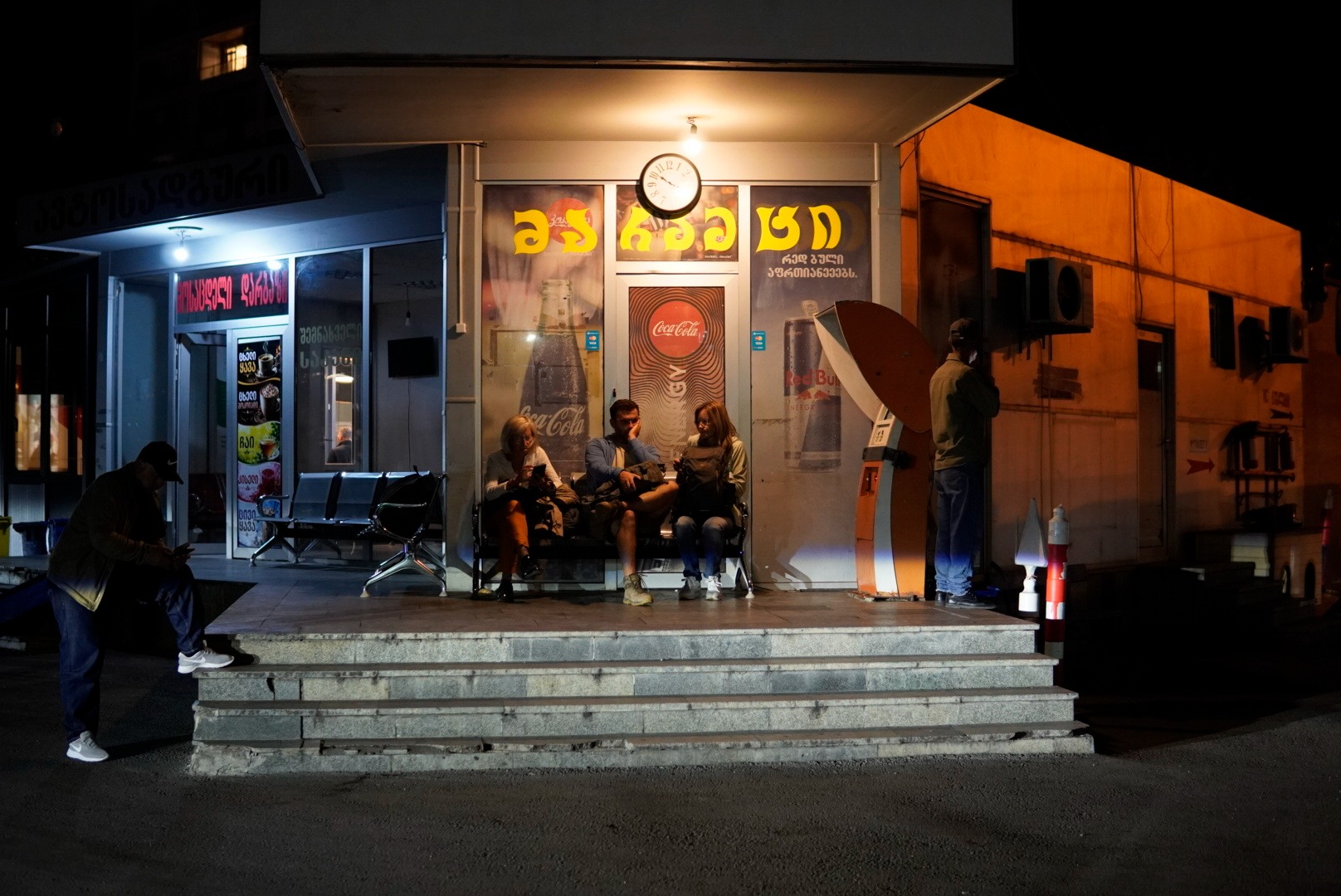
And then there are those dim little lights inside the tiny butkas, glowing onto the pavement at night, somehow making Tbilisi look exactly like itself.

***
Note 1: The names in this article have been deliberately modified to protect the privacy of respondents.
Note 2: The photos in the article do not necessarily match the shops described in the corresponding section.

