

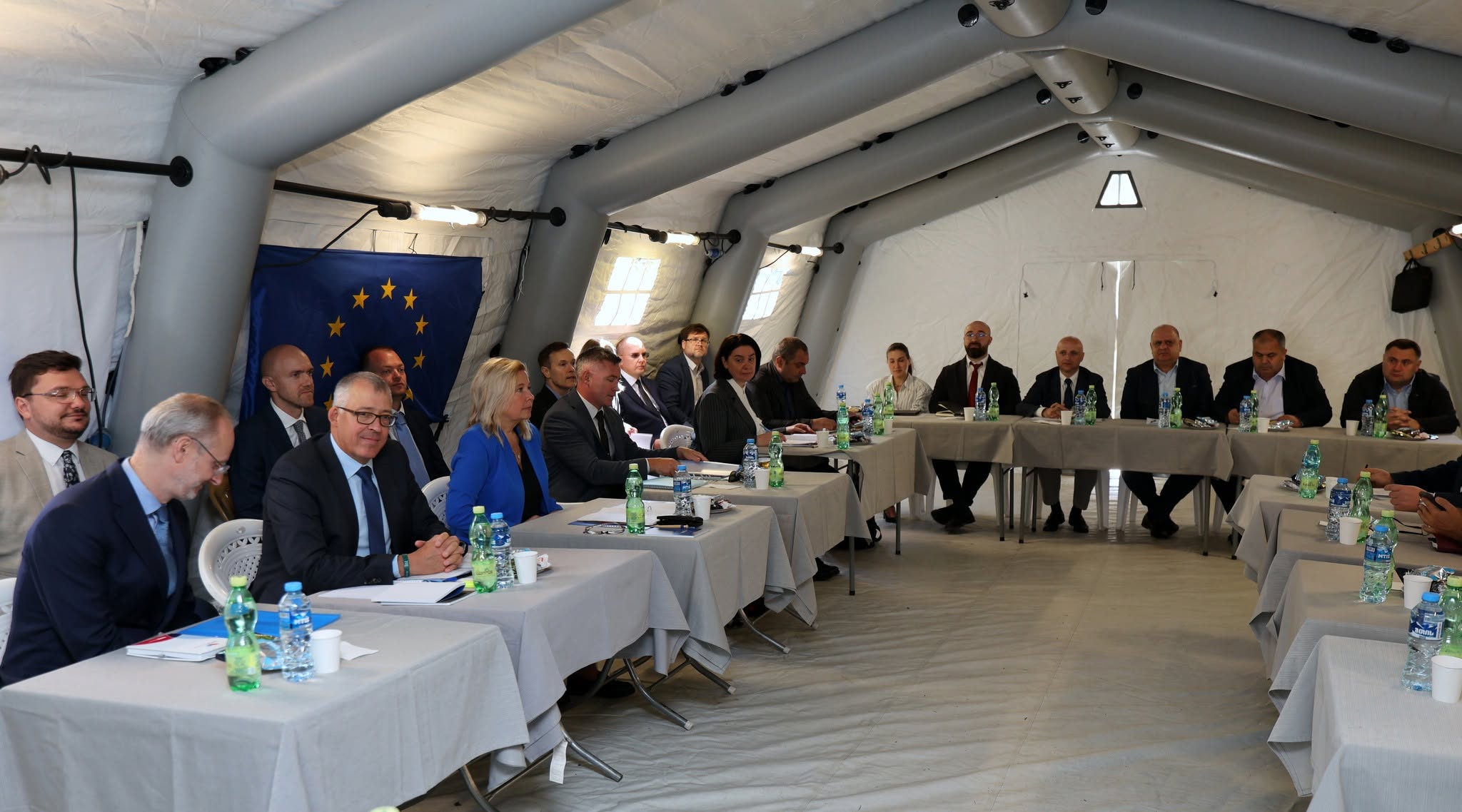
The 134th meeting of the Incident Prevention and Response Mechanism (IPRM) took place on September 8 in the village of Ergneti, near the occupation line in Georgia’s Russia-occupied Tskhinvali region.
The meeting, which brought together the representatives of Georgia’s central government and de facto authorities of Tskhinvali/South Ossetia, was co-facilitated by Bettina Patricia Boughani, Head of the EU Monitoring Mission in Georgia (EUMM), and Christoph Späti, Special Representative of the OSCE Chairperson-in-Office for the South Caucasus.
During the meeting, Tbilisi again raised the issues of illegal detentions and so-called borderization, as well as the need to hold accountable those responsible for the killing of Georgian citizen Tamaz Ginturi. Representatives of Tskhinvali’s de facto authorities, meanwhile, again called for the removal of the Chorchana/Tsnelisi police checkpoint and raised concerns about the well-being of Tamaz Goloev, a Tskhinvali resident currently in custody in Georgia proper on espionage allegations.
The next IPRM meeting is set to take place on October 22.
The Incident Prevention and Response Mechanism (IPRM) was established in 2009 within the framework of the Geneva International Discussions that followed the 2008 Russo-Georgian war. It serves as a forum for the regular discussion of security-related incidents and developments on the ground. IPRM meetings have been held regularly in Ergneti, near the Tskhinvali occupation line, with the participation of representatives from Tbilisi and the Tskhinvali de facto authorities. In contrast, meetings in Gali, in occupied Abkhazia, have been suspended multiple times, from 2012 to 2016, and again since 2018. The meetings are co-facilitated by the OSCE and the European Union Monitoring Mission in Georgia (EUMM).
SSSG Statement
Georgia’s State Security Service (SSSG) said that participants discussed “all significant” incidents recorded in the occupied Tskhinvali region and areas adjacent to the occupation line since the previous IPRM meeting. The discussions also addressed restrictions on freedom of movement and the operation of the so-called crossing points.
“The representatives of the State Security Service again strictly raised the issue of bringing to justice and ensuring the enforcement of law against the representative(s) of the Russian occupation force responsible for the murder of Georgian citizen Tamaz Ginturi,” the SSSG said.
The Georgian side also condemned the continued process of so-called borderization and highlighted what it described as a “growing trend of fundamental human rights violations” in the occupied Tskhinvali region.
Representatives of the central government also “strictly demanded the immediate release of all individuals in illegal detention,” the SSSG said.
EUMM, OSCE Statement
According to the co-facilitators, restrictions on freedom of movement remain in place, although they welcomed the more frequent opening of crossing points.
The co-facilitators “underlined that greater opportunities for cross-ABL [Administrative Boundary Line] movement can improve the daily lives, livelihoods and sense of security of conflict-affected women, men and children, and encouraged further steps towards the full reopening of the crossing points,” the OSCE press release said.
According to the press release, “detention cases remained an important part of the discussions,” noting that the EUMM and OSCE “reiterated their concern over continued detentions and called for a humanitarian approach to resolving all existing cases.”
“All participants reaffirmed the key role of the EUMM-managed Hotline in facilitating the timely exchange of information and contributing to stability along the ABL,” the release said, adding that “the Hotline continued to address a range of practical, security and humanitarian issues, including detentions, “borderisation” and socio-economic issues.”
Tskhinvali’s Statement
Following the meeting, Igor Kochiev, representing occupied Tskhinvali, told journalists that the issue of the Georgian police post near the village of Chorchana/Tsnelisi was discussed “quite seriously” during the meeting. Kochiev stressed that “the South Ossetian delegation confirmed that the only possible solution to the issue is the removal of the post and its withdrawal from the territory of the republic.”
Kochiev also raised the case of Tamaz Goloev, a Tskhinvali resident currently in custody in Georgia proper on espionage allegations. According to Kochiev, representatives of international organizations had sought access to Goloev to assess his health and detention conditions but were not permitted to visit him.
“We are told that Goloev is fine, but we do not trust the statements of the Georgian side,” Kochiev said. “International organizations, including the Red Cross, could visit him and check the conditions of his detention, but they are still not being allowed access to Tamaz.”
He said the Tskhinvali side would continue to press for representatives of the International Committee of the Red Cross (ICRC), or another international organization, to visit Goloev. “They will, of course, not receive exhaustive explanations, but they will be able to personally verify the state of his health,” Kochiev added.
Kochiev also said the de facto authorities had recorded no crossings of what they consider the de facto republic’s “state border” by Georgian police since the previous IPRM meeting, with what he described as one minor incident involving the EUMM being the only exception.
He further claimed that two violations of the airspace claimed by the Tskhinvali authorities had been recorded since the previous IPRM meeting, one involving a quadcopter and another involving an airplane. He also said that five cases of Georgian citizens allegedly crossing into the occupied Tskhinvali region had been recorded since July 23.
Also Read:

