



Russell
Palmer Political reporter
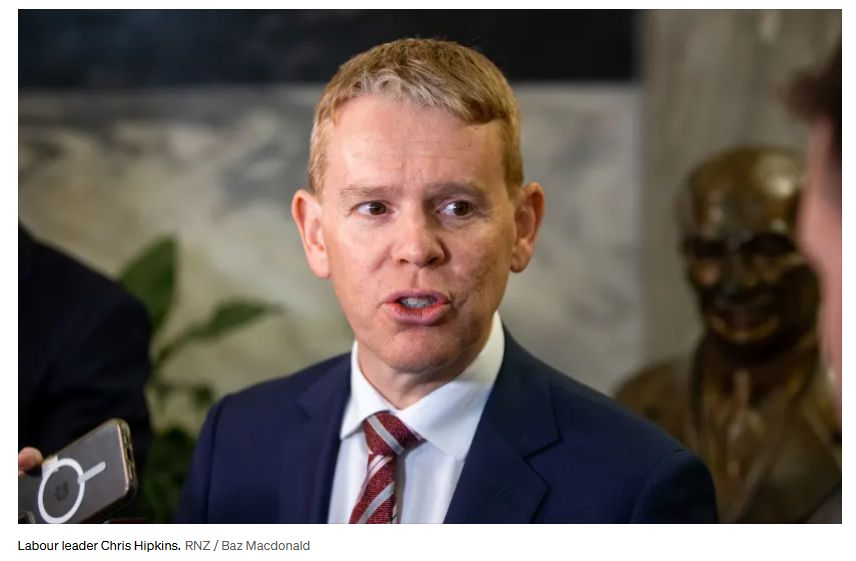
Labour
is calling the government’s stance on Israel an
embarrassment to the country, and says it is failing to meet
its responsibilities under the genocide
convention.
Britain, France and Canada are set
to ban imports from Israeli settlements in the occupied
West Bank, with British Foreign Secretary Ed Miliband saying
Israel is turning a blind eye to the ethnic cleansing of
Palestinians.
However, New
Zealand had not followed suit, with Foreign Minister
Winston Peters saying New Zealand has not traditionally used
trade measures to address foreign policy
issues.
Labour’s leader Chris Hipkins said that if
Labour was in government, New Zealand would be joining in
the sanctions against Israel.
He said the government’s
position on Gaza had also been “weak for the last three
years” and it was failing to fulfill its responsibilities as
a signatory to the international protocol against
genocide.
Advertisement – scroll to continue reading
“The current government’s position on Israel
is an embarrassment to the country,” he said.
“We
should be sanctioning Israel along with like-minded
countries like the UK, Canada, and France. These are our
friends who are now saying that what Israel is doing is
wrong and they should be sanctioned for it.”
He said
Labour would also be formally recognising
Palestine.
“New Zealand’s missing in action when it
comes to taking a principled stance on what’s happening in
Gaza. There is an unfolding genocide happening.”
A
spokesperson for the Prime Minister said the foreign
minister’s statement is the government’s
position.
‘There is an inconsistency in what we’re
saying’ – expert
Waikato University law professor
Alexander Gillespie said the government was wrong not to
join the trade sanctions, saying there was an inconsistency
in New Zealand’s approach.
“The Europeans have it
right. New Zealand’s response is that we don’t like blanket
bans, and that with the 38 settlers that we’ve got travel
bans on, that that’s a targeted approach,” he said.
He
said when it came to Russia and Ukraine, it was justifiable
to do so with an International Court of Justice opinion to
support it, and New Zealand did use trade to influence
foreign policy.
“So there is an inconsistency in what
we’re saying right now.”
He said imposing sanctions on
Israel would take “a considerable amount of work” but “if
they want to do it, they can do it”.
“You’ve just seen
that with 12 other countries that have joined together to do
it, but where New Zealand’s positioned itself is with
Australia where we’ve decided not to do that right now, and
there will be political reasons for that.
“Partly it’s
got to do with the non-recognition of Palestine, because if
you recognise Palestine, you ultimately agree to the
self-determination of the Palestinian people, and that would
mean you’ve got to do more against illegal annexation than
other countries.”
He said New Zealand had good
rhetoric around supporting a two-state solution but the
measures taken against Israel were “nowhere near as strong
as … other countries”.
He pushed back on the
suggestion that imposing sanctions could escalate the
situation for those in the Palestinian territories, saying
“I don’t think you could escalate the situation much more
than where it is now”.
Where it might get complicated
was if US President Donald Trump decided to back Israel and
introduce further trade tariffs against countries
sanctioning the occupied territories.
‘Remember what
happened last time’ – ACT
ACT leader David Seymour
noted while the government was concerned about settlements
that breached international law, New Zealand was “a trading
nation – we don’t generally use trade bans to make political
points”.
He said the conflict in the Middle East
“changes at such a rate of knots I don’t think anyone really
knows where it’ll be at next week”.
“We’ve got eight
weeks before the next election, but it does remind me that
just before the last election, we saw that absolutely barbaric
and disgraceful attack by terrorists of innocent people at a
music festival, and if we’re going to talk about the
run-up to the election, sometimes we should remember what
happened last time.”
Govt ‘just find excuses not to
do something’ – Greens
The Greens’ Foreign Affairs
spokesperson Teanau Tuiono said the government’s statement
was weak, and trade sanctions would be a good step
forward.
“What has our government done? Nothing. All
it does is follow what the US does, and as Israel’s
strongest ally as well, and we don’t hear anything from this
government as well.
“There was an opportunity for the
government to do something meaningful when other like-minded
countries were recognising the state of Palestine, and this
government dipped even though the official advice to the
Minister for Foreign Affairs was to recognise the state of
Palestine – and he didn’t.
“It’s a weak statement.
It’s a pattern of behaviour of weak non-action from the
government, and it’s disappointing.”
Greens co-leader
Chloe Swarbrick has had a member’s bill in the ballot since
December 2024, and has been pleading
for support on it from across the aisle – which would
see it skip the biscuit tin ballot – for well over a
year.
With Labour promising its support, Swarbrick a
year ago was punished
by Parliament’s Speaker for a week after saying if they
could find “six of 68 government MPs with a spine we can
stand on the right side of
history”.
New Zealand’s public broadcaster, providing comprehensive NZ news and current affairs, specialist audio features and documentaries.
Radio New Zealand is a Crown entity established under the Radio New Zealand Act 1995. Radio New Zealand News are vital elements in our programming, providing impartial news and information to New Zealanders every day. Radio New Zealand (RNZ) provides listeners with exciting and independent radio programmes in accordance with the Radio New Zealand Charter.

