


August 27, 2026
An important finding as a reason
for the pandemic increase of food allergies and even deaths.
New study published in Allergy Journal reports that
two commonly used food emulsifiers, soy lecithin (E322) and
diacetyl tartaric acid esters of mono- and diglycerides
(DATEM, E472e), impair intestinal epithelial barrier
integrity and activate inflammatory and immune responses.
Using front experimental systems, including human
gut-on-a-chips, stem cell-derived colon organoid-on-a-chips,
human peripheral blood immune cells, and mouse models of
allergy, the study provides evidence that these food
additives can affect molecular pathways relevant to chronic
inflammation and IgE development namely, allergic
sensitization.
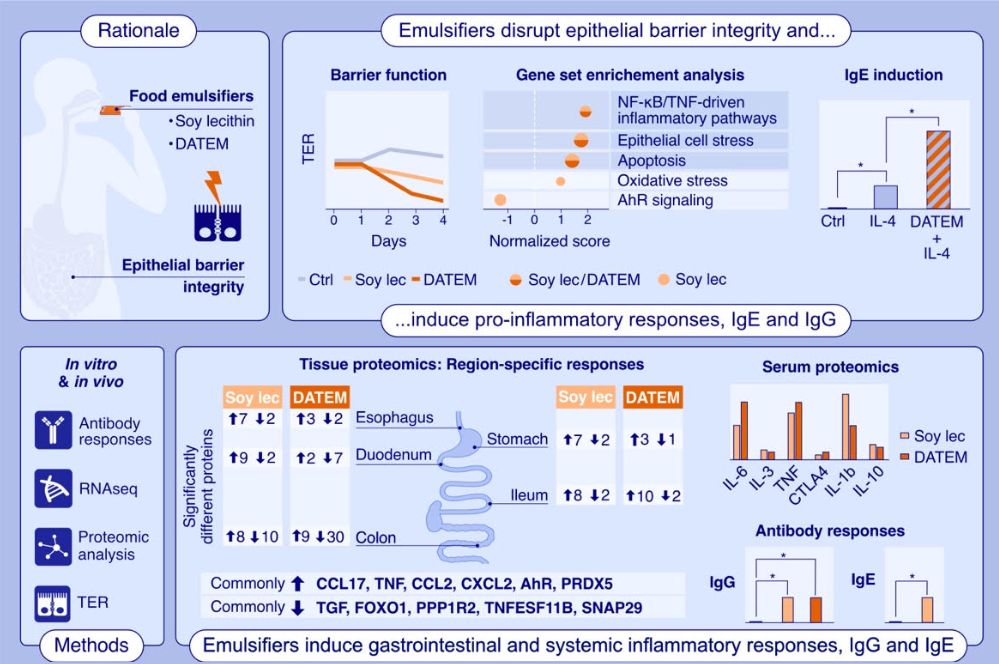
Key
Results
Both soy lecithin and DATEM impaired
intestinal epithelial barrier integrity, indicating that
exposure to these emulsifiers can directly cause gut barrier
leakiness.
The emulsifiers induced dose-dependent
cellular toxicity, with stronger effects observed as
exposure increased.
- Pro-inflammatory signaling
pathways were activated, including pathways involving TNF
and NF-B, which are central regulators of inflammatory
responses. - Both emulsifiers induced molecular
signatures associated with cellular stress and apoptosis,
suggesting that epithelial injury extends beyond transient
barrier disruption. - Soy lecithin additionally
increased oxidative stress, indicating that the two
emulsifiers can damage intestinal cells through partially
distinct biological mechanisms. - Despite these
mechanistic differences, both emulsifiers produced common
inflammatory responses, supporting the idea that different
additives may ultimately affect common immune
pathways. - In mice, emulsifier exposure within the
range of daily exposed doses produced inflammatory responses
throughout the gastrointestinal tract and was associated
with increased circulating inflammatory
mediators. - Soy lecithin increased total IgE and IgG
levels in mice, providing evidence that exposure can
influence systemic antibody responses and induction of
IgE. - DATEM enhanced IL-4-driven IgE production in
human immune cells, linking emulsifier exposure to an immune
pathway directly relevant to allergic
sensitization.
Advertisement – scroll to continue reading
Why These Findings Are
Important?
- These findings provide new mechanistic
evidence that commonly used food emulsifiers can directly
influence intestinal epithelial barrier integrity and immune
responses, expanding our understanding of how dietary
additives may interact with the gut. - By
demonstrating epithelial barrier impairment together with
activation of NF-B/TNF-associated inflammatory pathways,
the study identifies biologically relevant mechanisms
through which emulsifier exposure may contribute to a
pro-inflammatory intestinal environment.
The
observation that soy lecithin and DATEM converge on
inflammatory and stress-related responses.
The
combination of epithelial barrier disruption and increased
IgE-related immune responses provides an important
mechanistic connection between food-emulsifier exposure,
barrier dysfunction, and pathways allergy
development.
- Importantly, the study integrates
human gut-on-a-chip and colon organoid models with human
immune-cell experiments and mouse in vivo studies, providing
complementary evidence across several experimental systems
and strengthening the biological relevance of the
findings.
These results support the development
of more comprehensive approaches to food-additive safety
assessment that incorporate epithelial barrier function,
inflammatory responses, immune activation, and potential
interactions with the intestinal
microenvironment.

