



Kaya Selby
RNZ Pacific journalist
Analysis
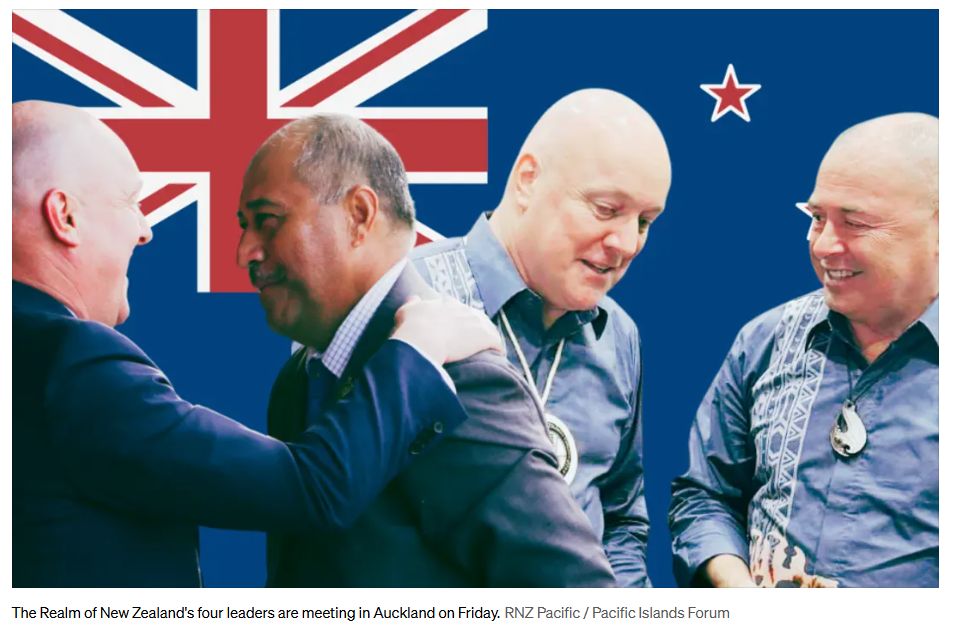
– The Realm of New Zealand’s four leaders are meeting in
Auckland on Friday morning for a chance for Prime Minister
Christopher Luxon to field their most pressing
concerns.
The meeting is also an opportunity for the
leaders – representing New Zealand, the Cook Islands, Niue
and Tokelau – to put their heads together ahead of the
Pacific Islands Forum (PIF) Leaders Meeting in Palau next
week.
The Cook Islands and Niue are independent states
in all aspects apart from defence and security, for which
New Zealand is responsible for assisting with. They also
have equal citizenship rights to Kiwis under the Cook
Islands Constitution Act 1964 and Niue Constitution Act
1974.
Their “free association” arrangements are unique
in the world, only seen elsewhere in Palau, the Marshall
Islands and the Federated States of Micronesia, which
associate with the United States under their respective
Compacts of Free Association.
Tokelau, on the other
hand, is a dependent territory governed from Wellington, but
given the autonomy to manage its own affairs
domestically.
Though their land is small, their oceans
are massive. This forces Wellington to think more
strategically, with the responsibility to defend nearly 2.6
million square kilometres of exclusive economic zones (EEZ),
in a moment of intense geopolitical competition between the
US and China.
Advertisement – scroll to continue reading
But while the Cook Islands is making
headway with global superpowers, Tokelau is facing a
financial crisis from a massive loss in fishing
revenue.
Meanwhile, all are reeling
from a fuel crisis, seeing massive price spikes at the
pump, for which New Zealand, where the Cooks and Niue get
all of their fuel – would have some influence.
Cook
Islands – going deep
In March of this year, Cook
Islands Prime Minister Mark Brown visited Wellington but
never met with Luxon.
Freshly re-elected for a
third term last week, Brown is seeing his New Zealand
counterpart face-to-face for the first time in nearly a year
– around five months since the two countries made
amends.
That now-infamous spat, which began in late
2024 over a security
deal with China, had been punctuated by a dodgy ship
registry, an attempt to shoehorn a special Cooks passport,
and an “independence” rhetoric from Brown that had irked
Wellington.
It was described by the Ministry of
Foreign Affairs and Trade (MFAT) as a breakdown in trust,
and before Brown doorstopped
New Zealand Foreign Minister Winston Peters during the
March visit, the two countries were only meeting through
officials.
Meetings between Brown and Peters, starting
in Peters’ Auckland living room, appear to have brought that
relationship back to normal.
Though they have signed
an agreement that supercedes anything Brown signed with
Beijing, along with ditching some of the controversial
policy ideas, Brown has not back down from his position that
the Cook Islands was on a “voyage of statehood”, insisting
his country is “growing in influence” globally.
That
may be true. The United States has recently deployed a new
Ambassador, Jared Novelly, who divides his time between NZ,
the Cooks, Niue and Samoa.
Novelly, speaking to
reporters when he arrived in Wellington last month, appeared
more interested in the Cooks than he did in New Zealand.
He has promised to be in the Cooks “often”, ranking it as
“either 1a or 1b on my priority list”.
The Trump
Administration has made no secret of its deep-sea mining
ambitions in the Pacific. It has begun issuing mining
licenses in its own Pacific territories, all the while
ramping up engagement with the Cooks over the last year and
earning exploration privileges along the way.
Brown
welcomed a seabed exploration mission into the Cooks’ EEZ
with open arms. When the mission returned
with its results at a ceremony last week, the US boasted
about the vast stretches of metal nodules it had found, far
exceeding what was previously believed to be
there.
For New Zealand, this may be a point of
contention. Wellington supports a moratorium on deepsea
mining in international waters before an international code
can be established. It would argue there are too many
“unknowns” in terms of environmental impact, especially
given the potential for mining to lay waste to marine
life.
It has, however, stated that it respects the
decisions of independent countries.
Crisis in
Tokelau
Beginning in February, Tokelau has been
bleeding money after being expelled from the Vessel Day
Scheme (VDS), a lucrative arrangement allowing the
autonomous territory to sell time in its waters to tuna
fishers.
The VDS is administered by the Parties to the
Nauru Agreement (PNA), a cartel of Pacific countries with
vast EEZs – of which New Zealand is not a member.
MFAT
maintains that, for all intents and purposes, Tokelau
manages its fisheries independently of Wellington.
But
RNZ has previously
reported that both Tokelauan and PNA country officials
have dwelt on New Zealand “interference” in Tokelau’s
fisheries, causing Tokelau to tell the PNA that they were
less able to make independent decisions.
Officials
have stated that they are “actively lobbying” PNA member
states to let Tokelau back in. The upcoming PIF leaders
summit would be an ample opportunity to do so.
The
territory’s finances are not readily available to the
public. But documents released under the Official
Information Act put estimated losses between February and
June at around
60 percent of Tokelau’s fishing profits.
That loss
would decimate its independent revenue and leaves it almost
entirely dependent on New Zealand aid – which as of yet has
not increased to make up for the
shortfall.
New Zealand’s public broadcaster, providing comprehensive NZ news and current affairs, specialist audio features and documentaries.
Radio New Zealand is a Crown entity established under the Radio New Zealand Act 1995. Radio New Zealand News are vital elements in our programming, providing impartial news and information to New Zealanders every day. Radio New Zealand (RNZ) provides listeners with exciting and independent radio programmes in accordance with the Radio New Zealand Charter.

