

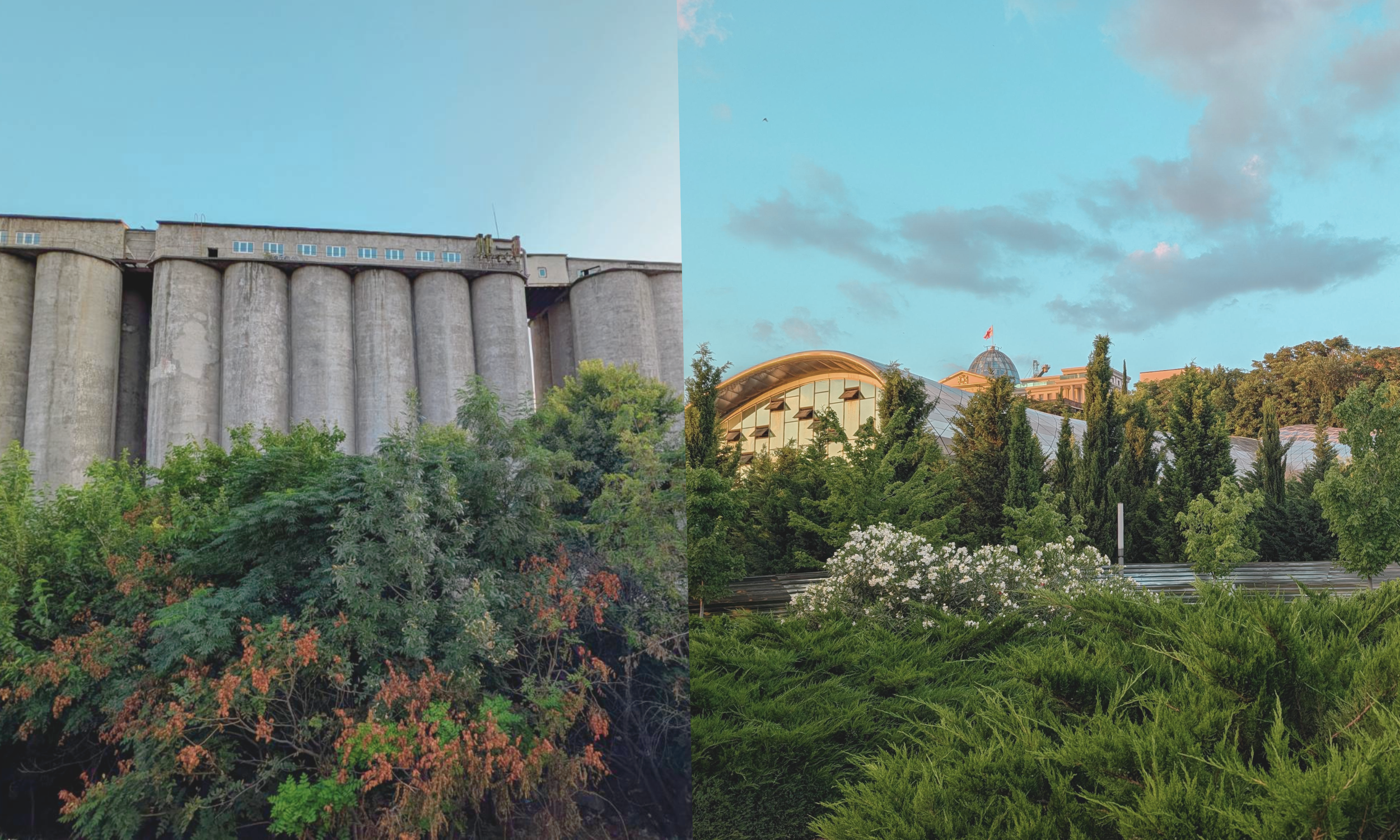
With the summer of 2026 came reports about the planned demolition of two very distinctive, yet not entirely dissimilar architectural landmarks in Tbilisi.
The first such landmark is “Silo” — a Soviet-era multi-functional mill plant in Tbilisi’s eastern Navtlughi settlement, recognizable by its cluster of tall grey concrete silos, the cylindrical structures traditionally used for storing grain and other bulk materials.
Another landmark, too, includes cylindrical tubes, but unlike Silo’s towers, these lie horizontally. Tbilisi’s Music Theatre and Exhibition Hall, better known as the Rike Tubes — or, in Georgian, Rikis Doqebi — is a pair of glass-and-metal modern structures located in Old Tbilisi’s Rike Park.

For many years, both Silo and the Rike Tubes remained without a clear purpose, with trees and plants growing around them. The growth came in a more brutal, uncontrolled way around Silo and in a more managed urban setting around the Rike Tubes, giving the modern landmark somewhat Brutalist undertones in the last years of their existence.

Both Silo and the Rike Tubes emerged from politically contested times. Silo’s construction began in the 1930s, during the height of the Soviet purges, while the Rike Tubes were built in 2011–2012, in the final years of United National Movement rule.
But if Silo’s memory and perception appear to have been shaped by its more secluded location and decades of service as a multifunctional automated plant, the Rike Tubes had neither the luxury of redeeming themselves away from the public eye, nor the opposite — a chance to redefine themselves through closer interaction with the public.

The dismantling of Rike Tubes began in July and continues despite the backlash from architects and parts of the public. The demolition of Silo began earlier but was temporarily suspended in the summer amid protests from members of the architectural community, who called for the structure to be preserved as a monument. In August, however, activists noticed that demolition had resumed.

On Silo
Silo, or Tbilisi’s No. 5 Flour Mill Plant, was built in the early 1930s to become one of the capital’s largest automated industrial facilities during the Soviet period. It was further expanded in the following decades, but eventually ceased operations and passed into private ownership after the collapse of the Soviet Union. The complex, covering more than 50,000 square meters, is known to comprise more than 80 cylindrical structures.

Architects familiar with the history say that the flour mill complex carried out multi-stage processing, from receiving and storing raw materials to milling them into flour, baking bread, and selling the finished product.

In 2026, it emerged that the investor planned to demolish the structure and build a residential complex in its place, having applied to city authorities for the necessary permit. In July, images from the site showed that demolition had begun, with visible dents appearing beneath the landmark cylinders.

Rikis Doqebi
Rike Tubes, or, in Georgian, Rikis Doqebi, a reference to their resemblance to doqi, a traditional clay wine-serving jug — are two connected glass-metal pieces of modern architecture designed by Massimiliano and Doriana Fuksas in 2010 and built in the final years of United National Movement rule (2011–2012). The landmark was intended to house art exhibitions and concert halls, but, while completed on the exterior, their interiors were never finished, and the facility was never opened. About 75 million lari (around USD 29 million at the current exchange rate) of public money is known to have been spent on their construction.

Following the change of government in 2012, Doqebi were conserved, landing on the sorrowful list of UNM-era modernist buildings struggling to reinvent themselves with new purposes, and was perhaps the unluckiest of them all. Recently, it was reported that the Foreign Ministry moved into the similarly largely abandoned Presidential Palace in the uphill Avlabari area, overlooking the tubes, while later in July authorities inaugurated a technology hub in the oval-shaped glass-and-metal former parliament building in Kutaisi.


The Doqebi met a different fate: in July, Tbilisi City Hall confirmed that it had approved their demolition, which is expected to be completed by December. The site was repeatedly privatised, and the current company – Rike Dom – plans to build a hotel there, although the project details remain unknown. The protest and pleas, including from the Fuksas architects, who offered to work with authorities on repurposing the landmark, were unsuccessful in stopping the dismantling process.
Silo’s Uncertain Future
Unlike Rike’s Doqebi, Silo is less well-known, except among architecture enthusiasts and locals who happen to pass along the busy roads surrounding it. Despite holes cruelly appearing under the Silo cylinders, and part of the top structure visibly damaged, the structure still stands upright, and it remains unclear whether the silo towers themselves — the most distinctive part of the plant — will survive the revived demolition efforts.

Professionals who have rallied against the demolition plans have criticised contemporary architectural decision-making for failing to take into account how local communities want to shape and inhabit their surroundings.
Citing international examples, they have suggested creating alternative uses for the tall structure and its surrounding area, with ideas ranging from climbing facilities to cafés to art spaces. They argue that the suburb currently lacks recreational spaces and have proposed transforming the site into one that could serve the local community while also preserving what they describe as an important cultural monument.

Doqebi’s Bitter Certainty
While there are still hopes of saving Silo, the outlook for Rike Doqebi is far more bleak.
Only a skeleton remains of one part of the structure, while another, thinner section is also being dismantled. Doqebi were never universally loved: while Georgian Dream authorities have been accused of political revenge against the previous government in greenlighting the landmark’s demolition, the structures also had their critics among the public and in architectural circles, who argued that the modern landmark had been wrongly inserted into the old town, distorting its historic panorama.

Still, even among Doqebi’s professional critics, there have been calls to preserve its architectural value by relocating the structures to a more suitable setting rather than simply demolishing them. For now, however, no such prospect appears to be in sight, and the greater fear may be not Doqebi’s disappearance itself, but the uncertainty over what will emerge in its place.


