



Kate Newton
Climate Change Correspondent
The
government considered cancelling some carbon auctions
altogether after its policy changes tanked the carbon price,
documents show.
In the end, ministers opted to stick
largely with the status quo, with officials warning that
unexpected changes could cause even more uncertainty among
carbon unit purchasers.
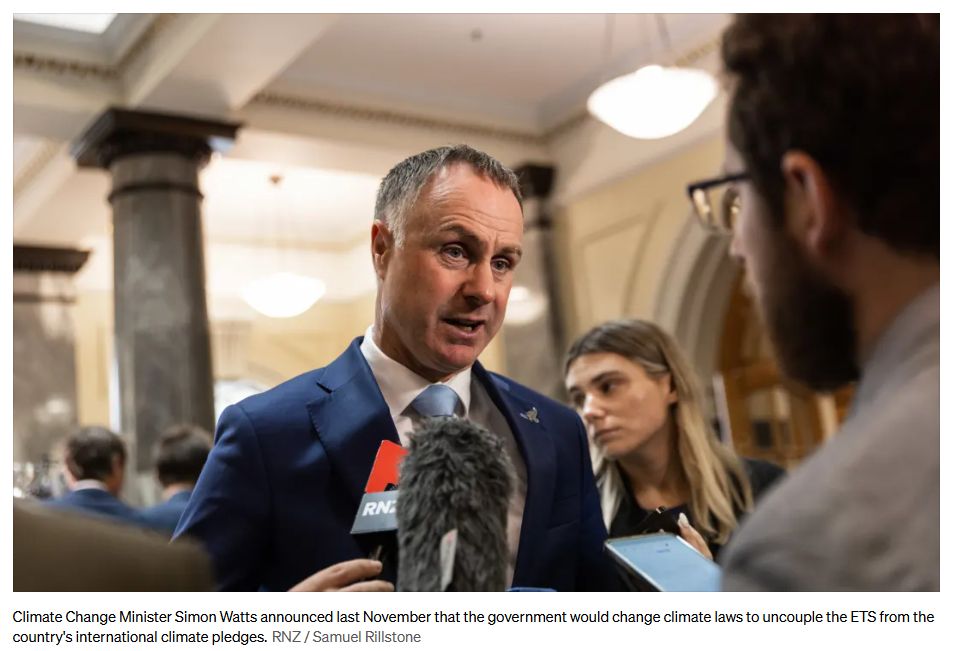
Climate Change Minister Simon
Watts announced in November last year that the
government would change climate laws to “uncouple” the
emissions trading scheme (ETS) from New Zealand’s
international climate pledges.
The ETS puts a price on
greenhouse gases and requires emitters to pay for carbon
units to cover their pollution.
It covers about 43
percent of New Zealand’s emissions but excludes
agriculture.
After Watts’ announcement, the New
Zealand market
price for carbon plunged overnight, from about $50 to as
low as $33.
A few weeks later, the final quarterly
government carbon auction for the year – one of several ways
in which emitters can buy carbon units – failed
to move a single unit.
Advertisement – scroll to continue reading
A day after the auction
failed, officials provided Watts advice on whether he should
send an early signal or announcement about the number and
price of carbon units that would be available in coming
years, to “help improve ETS market confidence and reduce
current price volatility”.
In documents proactively
released this week, they said that volatility had come about
“in response to recent government climate
announcements”.
Watts could send a signal in several
ways, from a low-key approach such as a speech, through to
an early decision ahead of the usual annual consultation
process, officials said.
However, they were not keen
on anything that circumvented consultation, saying it “sends
a signal or rushed and reactive policy”.
By late
February, with carbon prices still well below the auction
reserve price, Watts appeared to be considering an even more
drastic approach.
“We understand there may be interest
in sending an immediate signal to the ETS market through
pausing or cancelling 2026 auctions,” officials
wrote.
The logic behind cancelling auctions was to
create a scarcity of units, forcing emitters to buy them
elsewhere or spend from units they have stockpiled –
therefore pushing the carbon price back up.
The
minister could cancel auctions in 2026 by revoking auction
regulations or even changing the law, but both approaches
came with risks, officials said.
“[It] may send a
sharp message of intent to the market but may also raise
concerns around stable, predictable policy settings and
[climate law] integrity.”
It sent a signal “that the
government is willing to override the legislation for
short-term goals”, they warned.
Later auction
cancellations also considered
By March, there was no
more mention of cancelling auctions in 2026, but later years
were still on the table.
“We understand you may be
interested in setting auction volumes to zero for 2027 and
2028,” officials wrote to Watts.
That, too, “may be
seen as a significant departure from established practice”,
officials cautioned.
Despite that, Watts took a paper
to a meeting of a small group of ministers called the
Climate Priorities Ministerial Group that suggested
“effectively cancelling auctions for the next 1-2 years” as
an option.
In April, officials said that “novel
approach” was not supported by them or people buying carbon
units.
“Any potential benefit, in our view, is far
outweighed by the risk of signalling government appetite for
market intervention that responds to shorter term price
volatility rather than longer term
fundamentals.”
Market participants agreed, and had
informed officials that “would likely be seen as unexpected
and reactionary, potentially damaging market
confidence”.
In the end, the government’s preferred
option was to keep auction volumes and prices as they were
for 2026 to 2030, and auction slightly fewer units in 2031
than planned.
However, the final consultation document
still included an option to auction no units in
2027.
Just under half of submitters supported the
government’s preferred approach of keeping auction volumes
largely as they were.
A minority of submitters
supported having no units auctioned in 2027, but officials
said in July they did not recommend going ahead with that
option and confirmed their support for the government’s
preferred option.
Watts confirmed
last month that auction settings would stay as they were
for 2026 to 2030, with a decrease in units in 2031.
“A
stable ETS is key to delivering the emissions reductions
required to meet our targets. These settings provide the
certainty participants need to plan for the future,” Watts
said.
The settings were consistent with the country’s
emissions budgets – how many tonnes of greenhouse gases the
country can emit as a whole over a five-year period – and
aligned with advice from the Climate Change Commission, he
said.
New Zealand’s public broadcaster, providing comprehensive NZ news and current affairs, specialist audio features and documentaries.
Radio New Zealand is a Crown entity established under the Radio New Zealand Act 1995. Radio New Zealand News are vital elements in our programming, providing impartial news and information to New Zealanders every day. Radio New Zealand (RNZ) provides listeners with exciting and independent radio programmes in accordance with the Radio New Zealand Charter.

