



Tiana
Haxton RNZ Pacific journalist/presenter
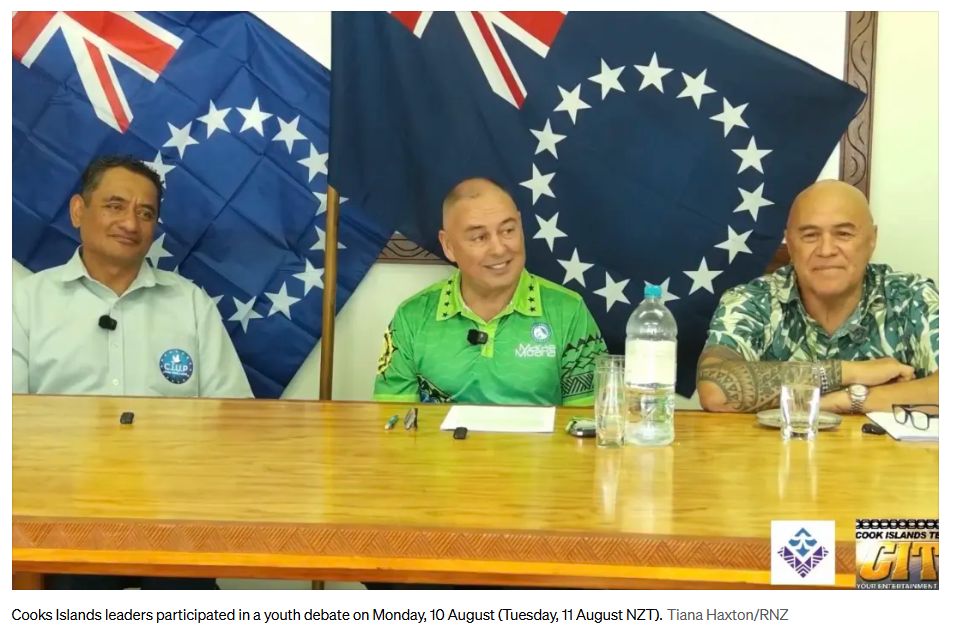
The
Cook Islands goes to the polls this week for its four-yearly
general election.
Like all countries in the region,
the Cooks has had its fair share of challenges due to global
shocks in recent years, and there’s a sense that voters are
looking for some stability, particularly around the cost of
living
The prime minister and leader of the Cook
Islands Party, Mark Brown is in no doubt about the priority
for people in this election.
He said for his party
it’s about consolidating the country’s growth and economic
recovery since reopening borders four years ago when the
Cooks emerged the Covid pandemic.
“Now, that strong
economic growth has allowed us to catch up, if you like,
with pay increases that were halted or paused during the
COVID period,” he said.
“It’s allowed us to increase
our welfare payments, to old age pensions, child benefit,
and these are all things that we’re gearing up to try and
meet the challenges of cost of living.”
Water
charges
Water utility charges are another issue in
this campaign.
The leader of the Cook Islands
Democratic Party, who is also the Leader of the Opposition,
Tina Browne, said if elected, her party would push to remove
water use tariffs for residential and agricultural users on
Rarotonga.
Advertisement – scroll to continue reading
“And we will review the present structure
of [water utility] To Tatou Vai,” she said.
“Of
course, water infrastructure costs money. The real question
is how that cost should fairly be met. I do not accept that
another household bill should automatically be the first
answer.”
For the United Party, ‘free water for all’ is
one of its main campaign points.
Leader Teariki
Heather said his party would remove residential water
tariffs should they form government.
“Absolutely, we
will revoke whatever legislation is against that for the
water tariffs,” he told RNZ Pacific.
His party’s
position is “water is a basic human right” and families
shouldn’t receive more bills during a cost-of-living
crisis.
“On top of electricity, on top of this water
tariff, the increase in cost in that, government should
absorb that.
“Budget of the government is really
looking at priority areas, especially this one.
“I
believe that the government can assist and accommodate for
the people of the Cook Islands at this particular
time.”
But Mark Brown pointed out infrastructure
maintenance isn’t free.
“The question is not whether
water should be free. The question is actually who’s going
to pay for it, because we’ve upgraded all of our water
intakes, 10 of them, around the island in the hills of
Rarotonga, and they all need to be maintained,” he
said.
Brown said households receive 38,000 litres free
of charge per month, while churches, schools and
agricultural spaces have no limit restrictions. Charges are
currently only being imposed on commercial
users.
“Most of these are, of course, in the tourism
industry with hotels, Airbnbs, resorts, that sort of thing,
and it’s only fair that they contribute to the upkeep and
maintenance of our water systems.”
Progressive Party
leader Te Tuhi Kelly said the free allocation for households
is more than enough.
“If you can’t manage that 38,000
litres, there’s something quite wrong there because that’s a
lot of water, a huge amount of water, but if you go over
that, I’m sorry, but you should be paying for
that.”
But he also thinks there are other ways
government could cover water infrastructure
costs.
“The water that we get from God is free; we
don’t pay for that. But God never put in place a delivery
system for us. We have to do that ourselves. Someone has to
pay for that.
“Now, whilst I’m for user pays, I think
there is probably a number of other options that we can look
at.”
Seabed minerals
Another issue Cook
Islanders are thinking about is whether the country should
continue the current government’s direction towards more
seabed mining activity.
Teariki Heather said he will
push for a referendum on seabed mining if the United Party
comes to power.
While he acknowledged that exploration
activities underway are potentially encouraging for
generating long-term wealth in the country, he said it’s so
critical to protect the future health of the country, that
the question of whether to progress seabed mining should be
put to the people.
“But the one that we will do is put
a referendum to ask the people of this country, whether this
yes or no, so it’s up to the people of this country [to]
actually decide. That’s number one that [we] will put out
[to] a referendum when elected to be government.”
Tina
Browne agreed that a referendum is the way to go, even if
science proves there would be no negative environmental
impact.
“Extraction should only be considered if the
evidence demonstrates that it can be done safely and in the
genuine interests of the Cook Islands people. Before
extraction occurs, our policy is that Cook Islanders should
have the final say through a referendum.”
But Te Tuhi
Kelly said there is simply not enough scientific information
to make a call yet.
“We’re neither for, nor we’re
against it.
“The issue for us as a party is that the
science doesn’t provide me with any enthusiasm. It’s young.
The data is not there.”
Mark Brown reiterated that the
Cook Islands is only conducting exploration and research
currently.
“It’s important that we gain the knowledge
and understanding of our deep sea before we make any
decisions on whether we move to extraction or the harvesting
of minerals.”
When asked if the Cook Islands Party
would consider a referendum, Brown said the science needs to
be complete first.
“Well, it’s a serious question, and
again, letting people decide – first we must be able to
provide the facts.
“We need to know the facts before
we can make a decision, and that’s why it’s important that
we conduct the exploration and research phase now
thoroughly, in a way that ensures that, when we do ask
questions of our people, our people are fully
informed.”
Foreign affairs
The country’s
relationship with New Zealand is a lingering issue too, at
least in the eyes of the big parties.
This
relationship came under strain after Wellington
suspended some funding as a consequence of a deal that
Brown’s government forged with China early last
year.
Funding
has been recently restored, and both governments say the
relationship is back on track.
But Teariki Heather
suggests there is a lot of work still to do to restore the
healthy relationship
“New Zealand is a special one for
us, and what we have discussed for this one, soon as
becoming government, soon as forming the government, we make
a trip, to show New Zealand how deep this relationship
is.”
Tina Browne also believes the relationship is
all-important and needs nurturing.
“The Cook Islands
should have constructive relationships with New Zealand,
China, Australia, the United States, and our Pacific
neighbours. We do not strengthen ourselves by unnecessarily
choosing between friends.”
But Mark Brown sees the
situation as proof that the Cook
Islands are able to “stand on their own two
feet”.
“We have diplomatic relations with over 70
countries around the world, including some of the biggest
economies around the world. We have a foreign policy that is
an independent foreign policy for the benefit of Cook
Islanders.
“The fact that we can negotiate with large
international countries, and the fact that we signed off on
our new security and defence agreement with New Zealand on
our own standing, and our own footing, on our terms, is
something that people now respect for the Cook Islands and
the government, the stand that we’ve taken.”
Issues
can be talked about all day, but it doesn’t mean much
without connecting to voters.
All of the parties
realise that having a good ground game, engaging with people
in their community, is the key to success.
Te Tuhi
Kelly said this is particularly the case with young
people
“There are a lot of kids [who] don’t want to go
to those political rallies because they find them boring. So
what do you do if you want to get them into politics? You
take politics to them.
“And what you do is you use a
medium that they’ve grown up with, and it’s a thing called
social media.”
The polls open at 8am Wednesday 12
August, local time (Thursday 13 August New Zealand
time).
The preliminary count for each constituency is
expected to be released throughout the same
night.
New Zealand’s public broadcaster, providing comprehensive NZ news and current affairs, specialist audio features and documentaries.
Radio New Zealand is a Crown entity established under the Radio New Zealand Act 1995. Radio New Zealand News are vital elements in our programming, providing impartial news and information to New Zealanders every day. Radio New Zealand (RNZ) provides listeners with exciting and independent radio programmes in accordance with the Radio New Zealand Charter.

